There’s a certain kind of room that just feels right the moment you walk in.
It’s not always the most expensive room. It’s not always the most decorated. But something in it holds together and if you look down, you’ll often find a rug doing that quiet work.
Persian rugs have been doing it for centuries.
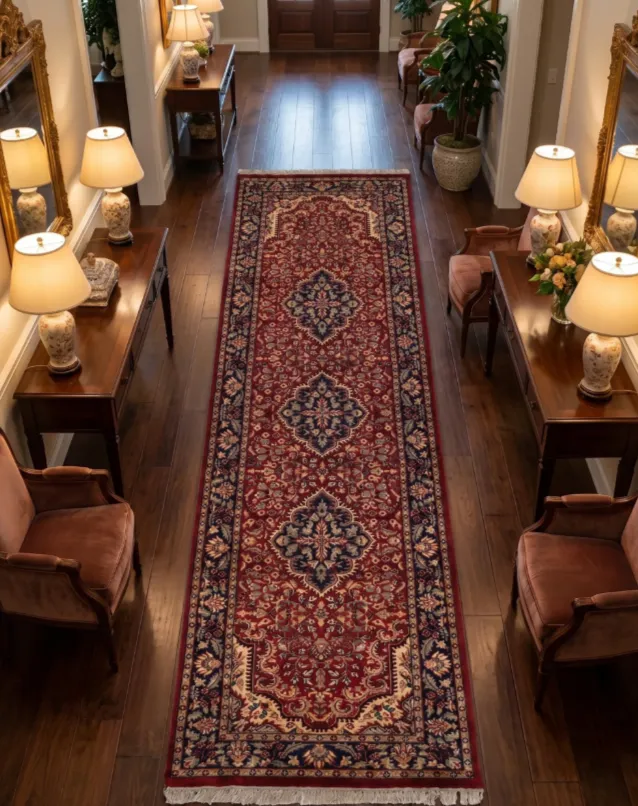
Most people can recognise one without ever having studied them. The dense borders, the layered geometry, the colours that seem to shift in different light. You’ve seen them in old photographs, in hotels, in your grandmother’s house. And yet their staying power has never really been about how they look on their own.
It’s about how they make a room feel.
A Handmade Rug Design That Doesn’t Age
Fashion moves in cycles. Persian rugs, somehow, don’t.
A hundred-year-old handmade carpet can sit beneath a carved wooden sideboard and look completely at home. That same pattern, dropped into an apartment with polished concrete floors and white walls, still works. That kind of flexibility doesn’t happen by accident. It’s the result of design principles built to last rather than designed to impress for a season.
Very few objects achieve that. Persian rugs have been doing it for generations.
The Rug Isn’t the Star. It’s the Director
Here’s where most people get Persian rugs wrong: they think they’re supposed to be the focal point.
They’re not. The best ones do something far more interesting. They make everything else look better.
Traditional weavers understood visual balance in ways that still feel sophisticated today. Large motifs were anchored by smaller repeating details. Strong colours were contained by borders. Even the most ornate designs rarely felt cluttered because every element served the whole.
That’s the principle worth borrowing.
When you’re furnishing a home, you pick a sofa because you love it. You pick a coffee table because it fits. But a handcrafted rug performs a different function. It brings those individual choices into conversation with each other. You might not notice the rug the moment you walk in. But if it weren’t there, you’d notice immediately.
Why People Still Reach for These Persian-Inspired Rug Patterns
Traditional Persian carpets aren’t for every home. Modern rooms are more relaxed, less ceremonial.
But strip away the formality and what people are still looking for is pretty much the same: something with texture, something with character, something that makes a room feel like it was put together rather than pieced together. And these days, people want to know the story behind what they’re buying, not just how it photographs.
That’s where handknotted rugs hold their ground. The slight colour variations, the imperfections in the pile, the details that catch light differently depending on where you’re standing, none of that happens in a factory. It happens because a person made it, and it’s exactly what makes the finished piece feel like yours rather than everyone else’s.
Where Kesari Home Fits Into This
We don’t make Persian rugs at Kesari Home.
Our work is rooted in Indian weaving traditions: natural fibres, considered design, rugs and carpets built for contemporary homes. But we’ve noticed something consistently: customers who are drawn to Persian rugs aren’t usually chasing a specific motif. They’re chasing a feeling.
They want something that feels real.
Our rugs like Sage, Zaroon and Urmi offer that kind of depth — pattern and visual interest without leaning heavily on ornament. The materials feel honest underfoot. The weave is visible. The rug brings warmth to a room without announcing itself.
The goal was never to recreate a Persian carpet. It was to carry forward the qualities worth keeping: thoughtful design, skilled craft, and something made to last and bring them into a form that fits how people actually live today.
Trends Fade. A Good Rug Doesn’t.
Think about how quickly interiors have moved over the last ten years alone. Industrial lofts. All-white everything. Fast furniture. Bouclé. Each wave arrives with conviction, most of it already feeling dated.
Rugs sit outside that cycle.
A well-made artisanal rug tends to outlast the furniture around it. It gets lived in: children on the floor, friends gathered around it, furniture rearranged across it season after season. At some point it stops being a design choice and becomes part of how the home feels. Part of the memory of the place.
That might be the real lesson Persian rugs have always carried.
Good design isn’t about making the loudest entrance. It’s about making something people are still glad to have ten years later.
Honest materials. Skilled hands. A design with enough confidence to stay quiet and enough depth to reward attention.
That hasn’t gone out of style. It never really does.