The outdoor chair is the hardest-working piece in any hospitality property. A lobby sofa might be sat on a few times a day. A pool chair at a busy resort is dragged across wet stone, stacked at night, splashed with sunscreen and chlorine, and baked in direct sun for ten hours, every day, for years.
That is why so many commercial outdoor furniture projects go wrong at the chair. Over the past fifteen years I have walked properties where dining chairs began to wobble within one season, where white powder coat chalked and blistered near the sea, and where rope seats sagged into hammocks before the warranty ran out. In almost every case the design was fine. The failure was in how the manufacturer was chosen and how the order was specified.
This guide is written for the people who carry that risk: hotel and resort procurement teams, importers and distributors, contractors and the designers who specify for them. It covers what commercial-grade actually means, how the main materials behave, how OEM and ODM work in practice, and how to vet a factory before you commit a container.
The Problem: Residential Specs Sold as Commercial
The term commercial-grade has no single legal definition. Many suppliers use it for any product sold to a business. The result is that buyers often receive residential-weight chairs at commercial prices.
The gap usually shows up in three places:
- Structure. Thinner aluminum walls, fewer welds and no internal reinforcement at the joints that carry the most load.
- Finishes. Powder coat applied without proper pre-treatment, so corrosion starts under the film where you cannot see it.
- Soft components. Rope, slings and cushions that are not UV-stabilised or solution-dyed, so they fade and weaken in one or two summers.
None of these are visible in a catalogue photo or a showroom sample. They only become visible on site, after the invoice is paid. The rest of this article is about closing that gap before you order.
What Commercial-Grade Should Mean for an Outdoor Chair
When I write a specification for hotel outdoor furniture, I avoid the word commercial-grade entirely. Instead I list the things that can be measured and checked.
Structural testing
Ask which standard the chair has been tested to, and ask for the report, not a logo. In Europe the reference is the EN 581 series for outdoor seating, and EN 16139 for non-domestic seating strength and durability. In North America, buyers often borrow ANSI/BIFMA test methods for seat and back loads. A chair tested at contract level will survive far more cycles than one tested at domestic level.
Frame engineering
For aluminum chairs, ask for the alloy and temper (6063-T5 or 6061-T6 are common), the tube wall thickness, and how the joints are made. Fully welded joints with internal sleeves at the back legs outlast bolted joints in heavy use. For stacking chairs, ask how many high they stack and whether there are bumpers to protect the finish.
Finish and corrosion resistance
Powder coat quality depends more on pre-treatment than on the powder itself. Ask whether the frames are cleaned and given a conversion coating before coating, what the film thickness target is, and what salt-spray hours the finish has passed (ASTM B117 is the usual test). For beach and marine sites, ask for a marine-grade or super-durable powder and stainless steel fixings.
Soft components
Rope, slings and fabrics should be solution-dyed, meaning the colour is in the fibre rather than printed on it. Ask for UV fade results in hours. For cushions, ask about quick-dry reticulated foam and the fire standard required by your jurisdiction, such as CAL 117 in California or BS 5852 and BS 7176 in the UK.
Comparing Outdoor Chair Materials
No single material is best. The right choice depends on climate, use pattern and how much maintenance the operations team will actually do.
| Material | Strengths | Limitations | Best suited to |
| Powder-coated aluminum | Light, rustproof, easy to stack and move, wide colour range | Finish can chip; cheap coating fails near salt water | Pool decks, restaurant terraces, high-turnover dining |
| Teak | Dense, naturally oily, weathers to silver-grey, long service life | Heavier; needs legal timber documentation; colour change surprises some owners | Luxury resorts, villas, garden dining |
| Synthetic rope on aluminum frame | Soft, contemporary look, breathable, comfortable without cushions | Rope quality varies widely; can stretch if tension is poor | Lounge areas, boutique hotels, beach clubs |
| Synthetic rattan (PE wicker) | Classic look, good for lounge seating | Low-grade PE cracks in UV; weave hides poor frames | Covered terraces, lounges |
| Stainless steel | Very strong, modern look | Grade 304 can tea-stain near the sea; 316 costs more | Coastal and urban projects with a contemporary brief |
A note on teak
Because this guide is published on a teak-focused site, it is worth being specific. Grade A teak comes from the heartwood of mature trees and holds natural oils that resist rot and insects. Lower grades contain sapwood, which is paler and less durable. Ask for the grade in writing, the moisture content at production (typically below 12 percent for outdoor use), and proof of legal origin. Buyers importing into the US face Lacey Act requirements, and buyers in the EU must meet the EU Deforestation Regulation.
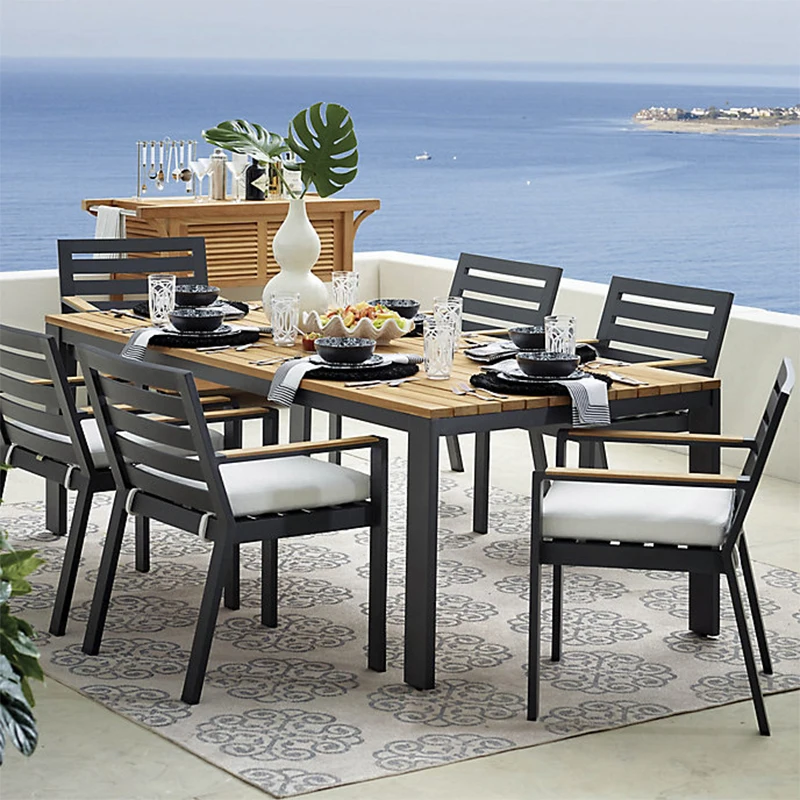
Teak also mixes well with aluminum. Many of the best-performing hotel chairs I have specified use an aluminum frame for strength and stacking, with teak armrests or slats for warmth and touch.
How to Evaluate an Outdoor Furniture Manufacturer
A good chair from the wrong factory is still a risk. Production consistency, communication and after-sales support matter as much as the sample on the table.
Factory or trading company?
Both have a place. A trading company can consolidate many product types into one container. A factory gives you direct control over materials, tooling and quality. For a commercial project where the chair count runs into hundreds, I prefer to deal with the factory that welds and coats the frames, or at least to know exactly which factory that is.
What to verify
- Years in operation and core categories. A factory that has made aluminum and teak outdoor furniture for a decade will understand failure modes that a new entrant has not met yet.
- In-house processes. Ask which steps are done on site: extrusion bending, welding, powder coating, rope weaving, teak machining, upholstery. Outsourced coating is a common source of finish failures.
- Engineering support. Can their team produce shop drawings, adjust dimensions for local seat-height norms, and suggest structural changes before tooling?
- Quality control system. Ask for incoming material checks, in-line inspection points and the final inspection standard, usually AQL sampling under ISO 2859-1.
- Commercial references. Ask for hotel or restaurant projects of similar scale, ideally in a similar climate. Then contact one.
- Warranty terms. Read what is excluded. A five-year frame warranty that excludes finish and rope is far weaker than it looks.
Where Kingmake fits as an example
When I review manufacturers in this category, Kingmake Outdoor Furniture illustrates many of the points above. Foshan Kingmake Industry Co., Ltd. was founded in 2008 and operates its own factory in Leliu Town, Shunde District, Foshan, one of China’s main furniture clusters. The company reports an 18,000 m² facility where welding, tube bending, powder coating and inspection are done in-house. It works in aluminum, rope, FSC-certified teak and PE rattan, and offers OEM, ODM and private-label production for hotels, resorts, distributors and brands. On certification, it states ISO 9001 for the factory and TÜV SÜD certification for specific product lines, including its armchairs.
Its Kingmake Outdoor Chair range is a useful reference point when building a shortlist. The page publishes the kind of detail buyers should expect from any supplier: 6063 aluminum frames with full TIG welds, a 200 kg rated load per seat, a 45 cm standard dining seat height, samples in about two to three weeks, and production from around 30 days after sample approval. It also sets warranty terms part by part, for example longer frame cover with a premium powder and longer cushion cover with branded fabric. MOQ is agreed per model, and a trial order can be split across several designs. As with any manufacturer, treat published figures as a starting point. Ask for the test reports, approve a production sample and arrange an independent inspection before a large order. That applies to every factory on your list, including this one.
OEM vs ODM: Which Route Fits Your Project?
These terms are often used loosely, so it helps to be precise.
| OEM (Original Equipment Manufacturing) | ODM (Original Design Manufacturing) | |
| Who owns the design | You, the buyer | Usually the manufacturer, adapted for you |
| Typical buyer | Brands, designers, hotel groups with a signature look | Distributors, importers, projects on a tighter timeline |
| Development time | Longer: drawings, prototypes, tooling | Shorter: existing models modified |
| Upfront cost | Higher, especially if new moulds are needed | Lower |
| Main risk | Unproven design in outdoor use | Similar products sold to competitors |
In practice, most hospitality projects use a hybrid. They take a proven ODM frame and customise finish colour, rope colour, arm detail, fabric and logo. This keeps the engineering risk low while giving the property its own identity. If you go full OEM, budget for at least two prototype rounds and agree in writing who owns the drawings and tooling.
Samples, Inspections and Lead Times
The sample stage is where most problems can still be fixed cheaply.
- Approve a golden sample. Sign and seal one approved chair, keep one at the factory and one at your office. Every inspection is measured against it.
- Inspect before shipment. A third-party pre-shipment inspection costs little compared with one bad container. For large orders, add a during-production inspection at around 30 percent completion.
- Plan realistic lead times. For customised commercial outdoor furniture from Asia, many factories quote around 30 to 60 days of production after sample approval, plus sea freight. Allow extra time around Chinese New Year, when many factories pause for several weeks.
Packaging, Container Loading and Shipping
Packaging decides how many chairs arrive in a sellable state. Ask for export cartons with corner protection, foam or film between finished surfaces, and a drop test result if available.
Container efficiency also changes your landed cost. Stackable chairs and knock-down (KD) designs fit far more units into a 40-foot high-cube container than fully assembled lounge chairs. Ask the factory for a loading plan with units per container before you compare prices, because a cheaper chair that ships at half the density is often the more expensive chair once it reaches site.
Finally, confirm Incoterms early. FOB leaves freight and insurance with you; DDP moves more risk to the supplier but usually at a premium.
Lifecycle Cost: The Number That Actually Matters
Purchase price is the easiest number to compare and the least useful. A more honest comparison divides total cost by years of service.
Consider a simplified example. Chair A costs USD 90 landed and needs replacing after three seasons. Chair B costs USD 150 landed and lasts eight. Over eight years, the property buys Chair A about three times, plus the labour, downtime and guest complaints in between. Chair B is the cheaper chair by a wide margin.
Add maintenance to the picture. Teak needs occasional cleaning and, if the owner wants to keep the honey colour, regular sealing. Aluminum needs fresh-water rinsing near the coast. Rope and cushions need cleaning and, eventually, replacement. A manufacturer that can supply spare cushions, rope kits and touch-up powder for several years is worth more than one that cannot.
Common Procurement Mistakes
- Approving from photos or a showroom sample. Showroom pieces are often hand-finished. Insist on a sample made on the production line.
- Specifying by price, not performance. Without written specs for alloy, wall thickness, coating and rope, you have nothing to enforce.
- Ignoring the site climate. A chair that performs well in a dry inland city can fail quickly at a beach resort with salt air and high UV.
- Forgetting stacking and storage. Operations teams stack and move chairs every night. Heavy, non-stacking chairs on a busy pool deck create labour cost and damage.
- Skipping the pre-shipment inspection. Problems found at the port of destination are expensive and slow to resolve.
- Not planning for replacements. Order 5 to 10 percent spares, or confirm the factory will keep the same colours and materials available for future reorders.
- Leaving IP and tooling ownership unclear. For OEM work, agree in writing who owns moulds and drawings.
Buying Checklist for Commercial Outdoor Chairs
Use this list when comparing suppliers. A strong manufacturer should answer every line without hesitation.
- Test reports to EN 581, EN 16139 or equivalent, issued for the model you are buying
- Frame material, alloy, wall thickness and joint method stated in writing
- Powder coat pre-treatment process and salt-spray hours confirmed
- Teak grade, moisture content and legal origin documents, where teak is used
- Solution-dyed rope and fabric with UV fade results
- Cushion foam type and fire certification for your market
- Stacking height and floor glides suited to your surfaces
- Golden sample approved and sealed
- QC plan with AQL level and third-party inspection agreed
- Packaging specification and container loading plan
- Lead time, Incoterms and payment terms confirmed
- Warranty terms, exclusions and spare-parts availability in writing
- Commercial references in a similar climate checked
Frequently Asked Questions
What is the most durable material for commercial outdoor chairs?
There is no single answer. Well-coated aluminum is the most practical all-rounder for high-turnover areas because it is light, stackable and rustproof. Grade A teak offers the longest service life for premium settings if the owner accepts its natural weathering. The quality of construction matters more than the material name.
How long should hotel outdoor furniture last?
With sound construction and basic maintenance, aluminum and teak frames in hospitality use commonly last seven to ten years or more. Cushions, slings and rope usually need replacing sooner, often within three to five years depending on sun exposure.
What is the difference between OEM and ODM outdoor furniture?
OEM means the factory produces your own design. ODM means the factory supplies one of its existing designs, often modified with your colours, materials or branding. ODM is faster and cheaper; OEM gives you exclusivity.
What is a typical MOQ for custom outdoor chairs?
It varies by factory and by how much customisation is involved. Standard models in standard colours may have low minimums, while new tooling or custom colours usually require larger runs. Always ask whether the MOQ is per model, per colour or per order.
Are teak outdoor chairs suitable for beach and poolside use?
Yes, Grade A teak handles salt air and moisture well. It will turn silver-grey unless sealed regularly, and it is heavier to move than aluminum. Pair it with stainless steel fixings, ideally grade 316, near the sea.
How do I check a manufacturer before placing a large order?
Request test reports and commercial references, approve a production-line sample, and arrange a factory audit and pre-shipment inspection through an independent firm. A virtual video tour is a useful first step but not a substitute for an audit on large orders.
How much lead time should I allow for a hotel outdoor furniture order?
For a customised order from Asia, plan for sampling, around one to two months of production, and four to six weeks of sea freight, depending on destination. Build in a buffer for holidays, inspections and customs.
Conclusion
Sourcing commercial outdoor furniture is less about finding the best-looking chair and more about removing uncertainty. Write measurable specs. Ask for test reports. Match materials to the site climate. Approve a real sample, inspect before shipment and compare suppliers on lifecycle cost rather than unit price.
The manufacturers worth a long-term partnership are the ones that welcome those questions. Experienced factories with in-house production, engineering support and OEM/ODM capability, such as Kingmake and its peers in the major furniture clusters, make that process easier, but the discipline still has to come from the buyer. Get the chair right, and the rest of the outdoor space tends to follow.